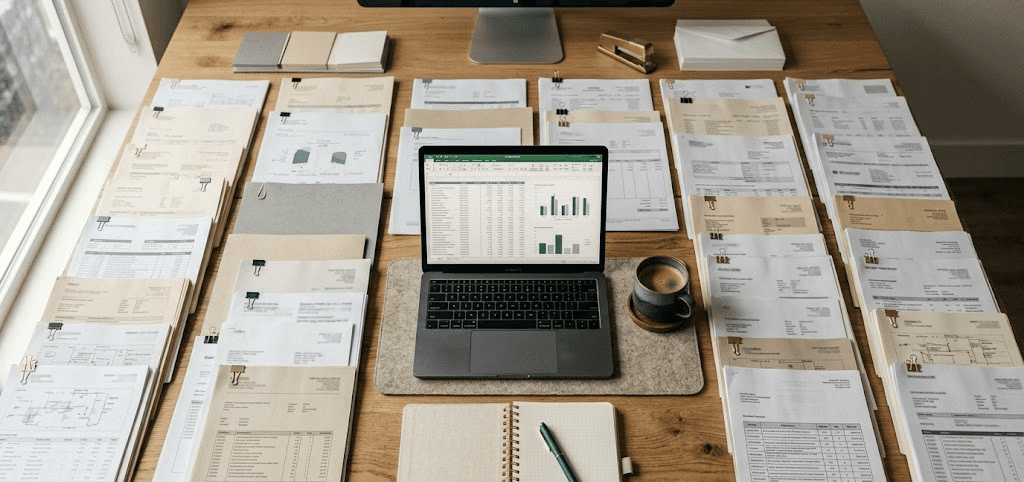
A buyer at one of our customers went on maternity leave last year. Two weeks later, her team realized they couldn't find the shipment status on 40 open POs. Every supplier conversation, every confirmation, every "yeah we'll have it by the 22nd" email, all of it lived in her Outlook. Nobody had the passwords. Production kept calling. They ended up cold-emailing 40 suppliers asking what they'd promised.
That's the thing nobody writes about when they talk about procurement "digital transformation." The single point of failure isn't the ERP. It's Karen.
You know this already if you run a small procurement team. Five buyers, maybe ten, a shared inbox, and the quiet awareness that half your institutional knowledge is one resignation letter away from disappearing. You're buying actual parts (castings, boards, machined components) from suppliers who don't know what a supplier portal is and wouldn't log into one if they did. And you're somehow expected to keep pace with Fortune 500 companies running procurement departments the size of your entire engineering org.
Here's the annoying truth: you can. Often more reliably than they can. But the way most blogs frame this (best practices! five tips! download our eBook!) misses what actually matters, so let me try something different.
Enterprise Procurement Is a Mess Too
Start here, because the feeling of being outgunned is mostly vibes.
We've talked to buyers at billion-dollar manufacturers who still track POs in Google Sheets because their Coupa implementation "isn't quite right yet." Three years later. We've heard from procurement directors who took nine months just to get internal approval to evaluate new software. Not buy it. Evaluate it.
The shiny stack looks different from the inside. The Hackett Group found that even the world-class procurement organizations they study only run with 21% lower labor costs and 29% fewer staff than their peers. Read that sentence twice. The elite, benchmark-winning, McKinsey-case-study procurement orgs aren't running dramatically leaner than the pack. They're just expensive and slightly more efficient. Everyone else is throwing people at the problem.
Enterprise category managers write sourcing strategies that buyers then try to execute with half the context. The supplier quality team isn't in the room when pricing gets negotiated. The contracts team shows up four weeks after the deal is supposedly done. It's procurement by relay race, and the baton keeps getting dropped.
When your whole team can make a decision in a standup, you're not behind. You're ahead on the thing that matters most, which is how quickly you can actually change how you work.
You Have Advantages You're Not Using
Being small is a gift if you stop treating it like a problem.
You can change a process on Monday and have it running by Wednesday. At Coupa-running Fortune 500s, a process change goes through a steering committee, a change management plan, and a training rollout. We once watched a 5-person team switch their entire quote intake workflow in four days because the head of procurement decided she was tired of the old one over lunch.
You're also starting from a clean slate. Yes, spreadsheets and email are rough. But they're infinitely easier to walk away from than a seven-figure Ariba implementation that nobody wants to admit was a mistake. No legacy system holds you hostage. No one on your team has ten years of muscle memory tied to a screen that loads in 18 seconds. You can pick up something new this week and actually use it by next Friday.
Your supplier relationships are real, too. When there are only five buyers, each one knows their suppliers by name, has probably been to the shop floor, and has the owner's cell number in their phone. That stuff vanishes in large orgs where procurement becomes a ticketing system and the supplier has no idea who's on the other end of the PO.
What to Actually Do With Your Lean Team
The best practices lists you'll find online will tell you to implement an S2P platform, roll out supplier scorecards, and build a category strategy. Those are fine for a 200-person procurement org. For a team of five, they're distractions. Here's what actually moves the needle when you're small.
Automate the follow-ups. Not the sourcing, not the contracts, not the onboarding. The follow-ups. Your buyers are spending somewhere between 15 and 25 hours a week sending "hey just checking in on PO 4471" emails. The work requires zero judgment, zero leverage, and zero domain expertise. It's the most pointless use of an expensive human you can imagine, and it's the first thing to kill. McKinsey found that agentic AI can deliver 20 to 30 percent efficiency gains in procurement operations. Almost all of that lives in the follow-up layer. An AI agent can send the email, read the reply, pull the date out of whatever mess the supplier wrote back with, and flag the ones that need a human. Your buyers stop being email robots and start doing the job you actually hired them for.
Next, fix quote intake. Right now your supplier responses come back as PDFs, emails with prices buried in paragraphs, Excel files with bespoke column structures, one voicemail, and a guy who just wrote numbers on a napkin and took a photo. Your buyer spends an hour a cycle building a comparison tab in Google Sheets. Every single time. From scratch. This is the category where AI tools have gotten genuinely good in the last 18 months. They can read any format, pull the structured data, normalize unit prices, and put everything side by side without the buyer touching a spreadsheet. The hour disappears.
And then, please, build one place where PO status lives. Not a spreadsheet updated on Fridays. A system that reflects the most recent supplier reply, automatically, so when production walks over asking about PO 4471 nobody has to dig through an inbox. This is the Karen problem from the intro. If one person leaving would destroy your PO knowledge, you don't have a system, you have a hostage situation.
That's basically the short list. Don't worry about scorecards yet. Don't build a category strategy yet. Automate follow-ups, fix quote intake, centralize PO status. The rest can wait.
"Just Hire Another Buyer" Is Still the Default Answer
Every procurement leader we've talked to has had this exact fight with finance. "Why do you need software? Just hire another person."
A fully-loaded buyer in the US runs somewhere in the 70k to 90k range. An offshore procurement coordinator is cheaper, maybe 4k to 6k a month, but they need training, supervision, and even then you can't throw thousands of POs at one person and expect consistent results. A single buyer can realistically manage 100 to 200 open POs with regular follow-ups. Past that, things fall through the cracks.
AI doesn't have that ceiling. Same tool, 500 POs or 5,000, same consistency, same night-and-weekend coverage. So the honest framing for finance is: you're either hiring two more buyers to cover the next product launch, or you're using software that lets the current team handle the volume without burning out. One manufacturer we spoke to put it this way: "We don't want to hire one full-time person every time we add a product to our roadmap." That's the constraint finance actually understands, once you put it in those terms.
The Direct Materials Gap
Here's the part that most "enterprise vs lean" comparisons miss. Coupa and SAP Ariba were built for indirect spend. Office supplies, software licenses, professional services. Stuff that fits into a punch-out catalog with pre-negotiated rates. For that category, they're genuinely good products.
For direct materials? The parts that go into what you actually build? Enterprise procurement stacks barely help. Ask a buyer at a $2B manufacturer how they manage their open POs with the job shops supplying custom machined parts. The answer is going to involve email, a spreadsheet, and probably a prayer. The expensive software doesn't reach the workflow where it matters most for manufacturers.
Which means the gap between you and the Fortune 500 buyer is narrower than it looks, especially if direct materials are the majority of your spend. The Fortune 500 buyer has better indirect tooling. You're both in email for direct. Whoever automates the email wins.
Don't Wait for a Better Quarter
The quote we hear most often from lean teams is some version of "we're too busy right now." Q1 is closing. Q2 has a product launch. Q3 is when we finally catch up. Q4 is planning.
The honest version of that sentence is "we're too busy to get less busy," which is a doom loop.
Pick the workflow that's eating the most hours and automate it. One workflow. Not a platform, not a transformation, not a steering committee. One workflow. Prove the time savings with real data from your own team, then use that to sell the next step internally.
Lumari is built for the Karen problem. It handles supplier follow-ups, reads the replies, and keeps PO status in one place so the knowledge lives in the system instead of in someone's inbox. If your team is running hundreds of open POs through email and every quarter feels worse than the last, that's what we built it for.
Sources
The Hackett Group, "World-Class Procurement Organizations See 21 Percent Lower Labor Costs" - https://www.thehackettgroup.com/hackett-world-class-procurement-organizations-see-21-percent-lower-labor-costs-while-digital-transformation-continues-to-raise-the-bar-on-procurement-performance/
McKinsey & Company, "Redefining procurement performance in the era of agentic AI" - https://www.mckinsey.com/capabilities/operations/our-insights/redefining-procurement-performance-in-the-era-of-agentic-ai
Share