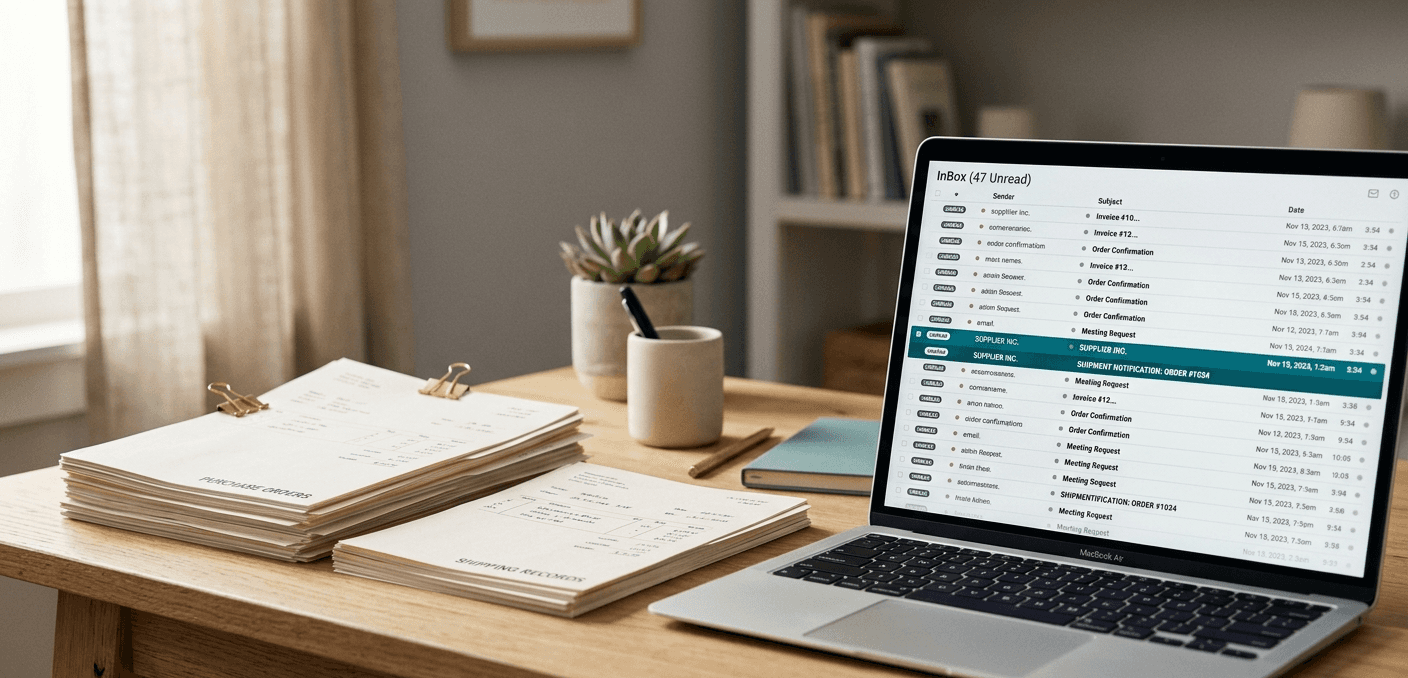

Your procurement team runs on spreadsheets. Not a slick ERP module. Not a purpose-built procurement platform. Spreadsheets.
And honestly? That's completely normal. A 2025 survey of 656 manufacturing executives found that 52% of companies still use email and file-sharing services for critical supplier data. Only 43% have adopted digital collaboration platforms. Most teams are duct-taping their processes together.
A construction company we spoke with manages projects across 44 countries with a five-person procurement team. Their system? Google Sheets. Same story at a biotech company tracking every purchase order and supplier record in Excel. We talked to a 3D printing manufacturer running their entire bill of materials in Google Sheets, updating it daily. These aren't outliers.
For most manufacturing procurement teams, spreadsheets are the system of record. Nobody wakes up and chooses spreadsheets because they love spreadsheets. They choose them because the alternatives cost six figures, take a year to implement, and require a dedicated admin to keep running. Spreadsheets bend, they're free, and everyone on your team already knows how to use them. But at some point, the approach starts cracking. When it does, you need a migration path that doesn't blow everything up.
The Mistake That Kills Most Procurement Software Rollouts
Before we get to the migration path: here's what not to do.
Someone in leadership decides "we need to get off spreadsheets" and kicks off a software evaluation. Six months later, they sign a contract with an enterprise procurement suite. Twelve months after that, they're still in implementation. Two years in, half the team is still using spreadsheets on the side because the new tool doesn't handle their specific workflow.
A pharmaceutical company we talked to called it "expensive shelfware." Bought the tool, paid for the implementation, and the team never fully adopted it. Six figures, gone. The Hackett Group found that digitally mature procurement teams achieve 2.6X higher ROI, but none of them got there by ripping out everything on day one.
Rip-and-replace doesn't work for procurement because your spreadsheets contain years of accumulated knowledge. Column names, color codes, conditional formatting, hidden tabs with supplier notes. That's all real information that doesn't transfer neatly into a new system.
Suppliers aren't going to change how they work, either. Supplier portals are dead. If your procurement tool requires suppliers to log into anything, you've already lost. Email is the channel, and no software purchase is going to change that.
And change management is genuinely hard. Your buyers are busy. Asking them to learn a new system while maintaining their current workload is asking them to do two jobs at once. Most people will just... not.
When Do Spreadsheets Actually Break?
Most growing manufacturers hit the ceiling somewhere between their 100th and 500th open PO.
The first thing you notice is stale data. The spreadsheet shows what was true the last time someone updated it. If a supplier emailed a new ship date yesterday and the buyer hasn't entered it yet, the spreadsheet is wrong. Your production planner is making decisions based on that wrong data. That's how you end up with line-down situations nobody saw coming.
Then there's the version control problem. "PO Tracker v3 FINAL (2).xlsx" is a meme for a reason. Multiple people editing the same file. Someone working off an old copy. Data conflicts everywhere. One team told us they spend the last week of every month doing "stock reconciliation," manually comparing their spreadsheet against what's actually in the warehouse and what their ERP says. The gaps are always bigger than anyone expects.
Nothing happens on its own, either. McKinsey estimates AI can deliver efficiency gains of 20 to 30 percent or more in procurement operations, but spreadsheets capture zero of that. They don't send emails. They don't alert you when a delivery date slips. They don't follow up with suppliers. Every action requires a human to remember to do it. One manufacturer built custom Python scripts to merge data across their Google Sheets, but that created its own maintenance problem. When the person who wrote the scripts left, nobody could touch the code.
Audit trails? Forget it. Who changed that delivery date? When? Why? You might be able to check the edit history, but good luck piecing together the full story across dozens of tabs and hundreds of rows. And once you're past a few hundred open POs, performance falls apart too. A spreadsheet works fine for 50. At 200, it's getting unwieldy. At 500, the formulas slow to a crawl, the file balloons in size, and you're scrolling through thousands of rows to find one part number.
Layer, Don't Replace
The approach that actually works is incremental. Don't rip out your spreadsheets. Pick one thing that's eating your team's time, automate just that, and see if it sticks.
Start With PO Follow-ups
For most manufacturing teams, this is the obvious first target. It's the biggest time sink, it's repetitive, and you'll know within a week if it's working. RFQ collection or supplier acknowledgment tracking are solid alternatives too. The point is: pick something specific enough to measure, broad enough to actually matter to your team's daily work.
Whatever tool you adopt, it has to work through email. Your suppliers aren't going to create accounts on a new platform. They're not learning a new interface. They're going to keep doing what they've always done: respond to emails. If a procurement tool requires supplier adoption, cross it off your list. Your suppliers are already drowning in portal login requests from their enterprise customers. They're not adding yours. The right approach is AI that reads and sends emails on your behalf, with approval controls you set. Suppliers see a normal email. They respond the way they always have. The automation happens on your side, invisible to them.
Run Both Side by Side
Don't shut down your spreadsheet on day one. Run both systems in parallel for two to four weeks.
Your team needs to see the AI getting things right before they'll trust it. Let them cross-check. The parallel run gives you real numbers, too. How much time does the old way take versus the new way? How many late POs are getting caught earlier? Those are the numbers you bring to leadership when they ask if it's working.
Then Migrate Data and Expand
Once the new tool is handling one workflow reliably, start migrating data from your spreadsheet. Import your supplier contacts, part numbers, historical pricing. Do it in batches, validate each batch, move on.
APQC research finds that over 60% of document errors trace back to manual data entry. Migration is when you finally catch the ones that have been hiding in your spreadsheets for years. Some data won't migrate cleanly. Those color-coded cells and cryptic abbreviations that only Carol understands? They're really just prompts for a conversation about standardizing your data. (Every team has a Carol. Sometimes Carol has already left, and you're staring at a yellow-highlighted cell with no idea what it means.)
Once PO follow-ups are running smoothly, pick the next workflow. RFQ management is a common second step. Spend analysis is another good one. Same playbook each time: layer it on, run in parallel, validate, transition. Over 6 to 12 months, you can migrate most of your critical workflows off spreadsheets without the big-bang cutover that kills most procurement software rollouts.
What to Look for in a Migration-Friendly Tool
Most procurement tools aren't built for gradual migration. They want you all-in from day one.
If it takes more than two to four weeks to see your first result, something's wrong. Connect your email, import your open POs, start seeing automated follow-ups within days. That's the bar.
Supplier onboarding should be zero. If the vendor says "we just need your suppliers to..." stop the conversation right there.
It has to work with your existing ERP. You're not replacing SAP or NetSuite. The tool should pull PO data and push status updates back. If it can't talk to your ERP, you've just created another data silo.
Here's the one people forget: it should bend to your process, not the other way around. Maybe you follow up on day 3, then day 7, then escalate. Maybe you have different rules for critical parts versus commodity items. A tool that forces you into its generic workflow is a tool your team will ignore.
And here's a test most buyers skip: ask the vendor to export all your data right now, in CSV or Excel, during the demo. Watch their face. If they hesitate, or start talking about "data migration services," that tells you everything about what leaving will look like.
Forget Feature Lists
Here's the thing nobody in procurement software wants to admit: most of these tools were designed by people who've never sent a PO follow-up email in their lives. The UX reflects it. That's why your team drifts back to their spreadsheet. Not because they're resistant to change, but because clicking through five screens to check one delivery date is objectively worse than scrolling to row 47.
Start small and prove value fast. Keep email as the supplier channel. Don't underestimate the well-organized spreadsheet, either. It's the benchmark your new tool needs to beat, whether you like it or not.
We built Lumari around exactly this migration pattern. Connect your email, import your open POs, and you're automating follow-ups in days. No supplier portals, no data lock-in. Your spreadsheet stays until you're ready to let it go.
Sources
BusinessWire, "Half of Companies Still Use Email or In-Person Meetings to Share Critical Supplier Data" - https://www.businesswire.com/news/home/20250909900208/en/Half-of-Companies-Still-Use-Email-or-In-Person-Meetings-to-Share-Critical-Supplier-Data
McKinsey & Company, "Redefining procurement performance in the era of agentic AI" - https://www.mckinsey.com/capabilities/operations/our-insights/redefining-procurement-performance-in-the-era-of-agentic-ai
The Hackett Group, "Digital World Class Procurement Teams Achieve 2.6X Higher ROI" - https://www.thehackettgroup.com/the-hackett-group-digital-world-class-procurement-teams-achieve-2-6x-higher-roi/
Share