
The tariff environment right now? It's chaos.
Expanded US-China tariffs, fresh steel and aluminum duties, trade policies shifting with Mexico and the EU seemingly every other week. The cost basis for imported components has changed a lot since early 2025, and it's not slowing down. If your procurement strategy still assumes stable tariff rates and a reliable single-source supplier in China, you're already behind. This isn't a rounding error anymore. It's the thing that determines whether you hit your margin targets this year. McKinsey documented one industrials OEM that hit $370M in first-year savings through procurement changes. That's survival math.
This isn't a policy article. It's what procurement teams at manufacturing companies should actually be doing right now.
How Big Is the Tariff Problem for Manufacturers?
Let's put some numbers on it.
Section 301 tariffs on Chinese goods started at 25% on many manufactured components and have kept expanding through 2025 into 2026. Steel and aluminum tariffs under Section 232 sit at 25%. The Biden-era increases on EVs, semiconductors, batteries, and critical minerals added more. And the current administration has stacked additional duties on top of all that.
Here's what that actually looks like on a P&L.
If you're sourcing 30% to 50% of components from China (common in industrial equipment, electronics, consumer products, automotive), a 25% tariff translates to a 7% to 12% increase in total material costs. On a $40M annual spend, that's $3M to $5M gone.
For a company doing $150M in revenue with 8% operating margins, $4M in unexpected cost wipes out a third of your profit. That's a crisis.
Why Can't Traditional Procurement Strategy Keep Up?
Most manufacturers built their sourcing strategies over years of qualifying suppliers, negotiating pricing, squeezing out cost. That work pointed to China, Southeast Asia, wherever landed costs beat domestic alternatives.
Tariffs break that math. And they break it faster than procurement teams can react.
The Speed Problem
New duties on a component category drop on a Monday. Your POs are already in transit. Next quarter's pricing is already quoted. Production schedule's set.
You don't have six months to run a sourcing event, qualify new suppliers, and transition production. You might not even have six weeks.
Traditional RFQ cycles at most manufacturers take 4 to 8 weeks. By the time you've found alternative suppliers, sent RFQs, collected quotes, and placed new orders, you've already eaten months of inflated costs. The response cycle most teams are built for just doesn't match how fast tariffs move.
The Visibility Problem
Try asking your procurement team this: "Exactly how much of our annual spend is exposed to the new tariffs on Chinese-origin steel components?"
Answering that means knowing which suppliers source from China (not just which suppliers are in China, since plenty of domestic distributors source from there too), which HTS codes apply to your components, what the current rates are, and what percentage of total spend those components represent. Most manufacturers can't answer this in less than a week. Some can't answer it at all without a manual audit.
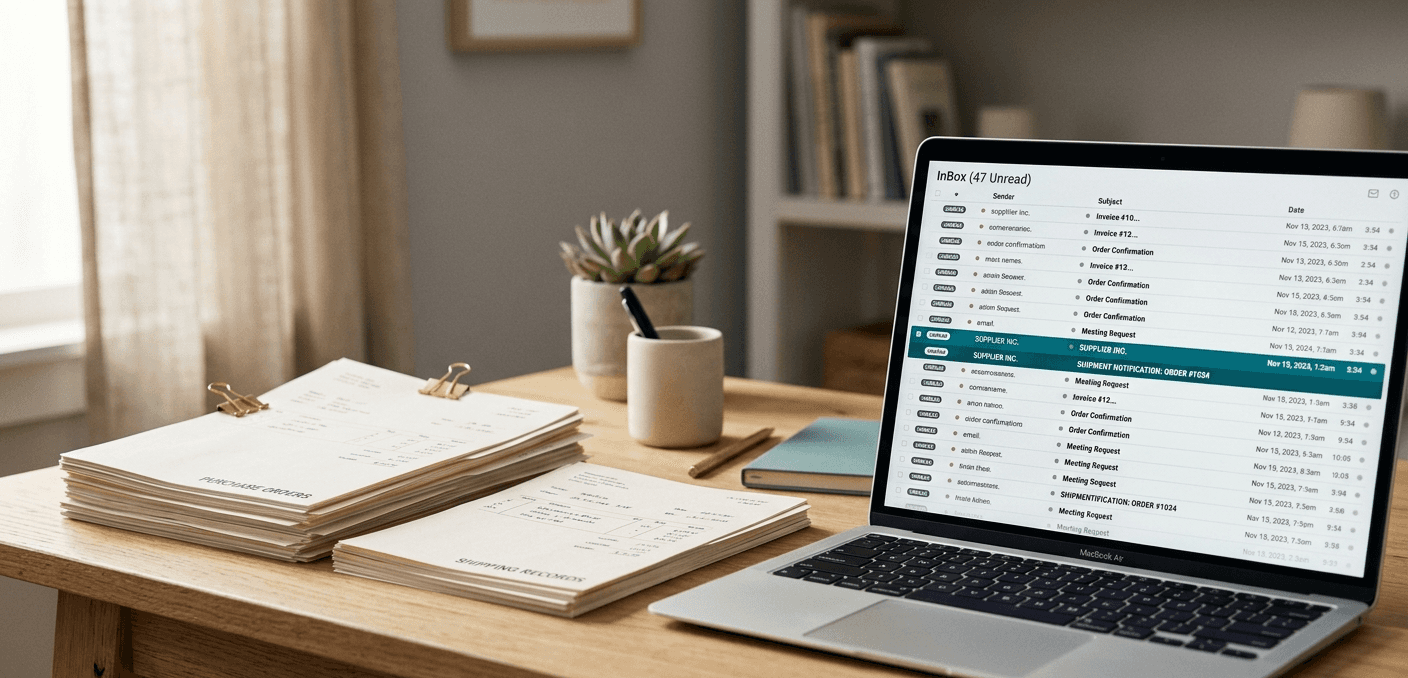
The data you'd need to react fast doesn't exist in a usable format at most companies. It's scattered across ERP records, supplier quotes buried in email threads, outdated spreadsheets that nobody trusts but everyone references.
The Single-Source Trap
Tariffs expose single-source risk faster than almost anything else.
Say 80% of your machined aluminum housings come from one supplier in Dongguan and a 25% tariff hits that category. You don't have an alternative ready. Qualifying a new supplier for a critical component takes 3 to 6 months. During that time, you're paying the tariff on every single invoice.
One electronics manufacturer we spoke with had 60% of their PCBA assemblies sourced from a single facility in Shenzhen. When tariffs expanded to cover their product category, component costs jumped overnight. They spent five months qualifying domestic alternatives, absorbing an estimated $1.2M in excess tariff costs they couldn't pass through to customers on fixed-price contracts.
Five months. $1.2M. That's what not having a backup plan costs.
What Should Procurement Teams Actually Do About Tariffs?
Here's what you should be doing. Not next quarter. Now.
Map Your Tariff Exposure in Detail
Most teams genuinely don't know where their actual exposure is. Fix that before anything else.
Pull your top 100 purchased components by annual spend. For each one, figure out the real country of origin (not the supplier's address, but where the part is actually made), the applicable HTS code, the current tariff rate, and the annual spend at current pricing.
This takes about a week if you're doing it by hand. But the output is worth it: a tariff exposure map showing exactly where your risk concentrates. Most teams find that 60% to 80% of their exposure sits in just 15 to 20 components. That's where you focus.
LevaData can speed this up if you've got access. Honestly, even a well-structured spreadsheet beats flying blind.
Build Alternative Supplier Lists Before You Need Them
The worst time to look for a new supplier is when you're desperate for one. And that's exactly what most teams do when tariffs hit.
For every component with real tariff exposure, identify 2 to 3 alternative suppliers in tariff-neutral regions. Domestic US, Mexico (assuming USMCA compliance), countries not currently targeted by duties. You don't need to qualify all of them right now. But you should have names, contact info, a preliminary capability assessment, and a budgetary quote.
Think of it as insurance. When tariffs change, you want to be weeks away from switching. Not months.
Rank components by risk (tariff cost times probability of increase) and start building alternative supplier lists for the top 20. Send preliminary RFQs to get budgetary pricing. You're not committing to anything, just building options so you're not scrambling later.
Run Faster RFQ Cycles
If your typical RFQ cycle takes 6 to 8 weeks, that's too slow when costs can change in days.
Where does all that time go? Drafting and sending the request eats a day or two. Then you wait 1 to 3 weeks for supplier responses, chasing the ones who ghost you the whole time. After that, 2 to 3 days pulling quotes from different formats into a comparison. Another week for internal review. Then 3 to 5 days for the final decision and PO issuance.
McKinsey estimates AI can deliver efficiency gains of 20 to 30 percent or more in procurement operations. The biggest time sinks, chasing suppliers and manually extracting quote data, are exactly the steps that compress well with automation. Automated follow-ups cut response collection time in half. Automated quote extraction kills the days spent copying numbers from PDFs into spreadsheets.
A team that can run an RFQ cycle in 2 to 3 weeks instead of 6 to 8 can actually respond to tariff changes in the same quarter they happen, instead of eating inflated costs while a sourcing event crawls along.
Dual-Source Your Critical Components
If there's one thing on this list you actually do, make it this one.
Any component over $100K in annual spend that's currently single-sourced from a tariff-exposed region? Dual-source it. Split volume (70/30 or 60/40) across two suppliers in different countries so both stay active and you've got a proven backup if one becomes cost-prohibitive.
Yes, it costs more upfront. You lose some volume discount, and qualifying a second supplier takes time and money. But when your primary supplier's costs jump 25% overnight, you can shift volume to the secondary within days instead of months.
One industrial controls manufacturer told us they spent $80,000 qualifying a domestic secondary supplier for their main enclosure component in early 2025. When tariffs expanded later that year, they shifted 60% of volume to the domestic source within two weeks. They estimated the dual-sourcing strategy saved them $350,000 in the first year alone, net of the qualification cost.
That's a 4x return on an $80K insurance policy.
Build Tariff Scenarios into Quarterly Planning
Stop treating tariffs as one-time events. They're not. They're a recurring variable now.
For each critical commodity, model a few scenarios: tariffs stay the same, tariffs increase by 10 to 15 percentage points, tariffs decrease or exemptions get granted. For each one, map the cost impact and your response plan. Which alternative suppliers would you activate? How fast could you shift volume? What's the cost of switching?
It's a lot of work the first time. Won't lie about that. But once you've built the framework, quarterly updates take an afternoon. When the next announcement drops, you're acting in days instead of scrambling for weeks.
It All Comes Back to Data
Everything above falls apart without good data. Most manufacturers don't have it.
You need to know what you're spending, with whom, where components actually originate, what alternatives exist. Spend data lives in the ERP but it's coded inconsistently. Supplier data lives in email threads and in buyers' heads. Country-of-origin information? Buried in supplier agreements nobody's opened since 2023. Or not tracked at all.
According to a 2025 survey of 656 manufacturing executives, 52% of companies still rely on email and file-sharing services for critical supplier data. In 2025. That's why tariff exposure mapping takes weeks when it should take hours.
The Hackett Group found that GenAI adoption can boost staff productivity by 25% or more. The teams that respond fastest to tariff changes have already got centralized communication data, structured quote history, and current supplier information. They can map exposure in hours because the data's already there. They run RFQs faster because they're not starting from scratch every time. The real gap isn't knowledge. It's data.
Before the Next Announcement Drops
Nobody knows exactly where tariff policy goes over the next 12 to 24 months. But the direction's clear: trade barriers keep going up, supply chains are regionalizing, and procurement teams are expected to handle all of it with the same headcount they had two years ago.
The team that can quantify tariff exposure, present alternative sourcing plans, and execute fast? That team gets a seat at the executive table. Tariffs have made procurement more strategic than it's been in decades. The teams that figure this out first will be the ones their companies actually listen to.
When tariffs shift overnight, the bottleneck is almost always the same: how fast can you get quotes from alternative suppliers and make a decision? Lumari handles the RFQ grind, chasing suppliers for responses, pulling quotes out of messy PDFs, normalizing everything into a comparison you can actually use, so your team spends its time on the sourcing decisions that protect your margins.
Sources
McKinsey & Company, "Aim higher and move faster for successful procurement-led transformation" - https://www.mckinsey.com/capabilities/transformation/our-insights/aim-higher-and-move-faster-for-successful-procurement-led-transformation
McKinsey & Company, "Redefining procurement performance in the era of agentic AI" - https://www.mckinsey.com/capabilities/operations/our-insights/redefining-procurement-performance-in-the-era-of-agentic-ai
BusinessWire, "Half of Companies Still Use Email or In-Person Meetings to Share Critical Supplier Data" - https://www.businesswire.com/news/home/20250909900208/en/Half-of-Companies-Still-Use-Email-or-In-Person-Meetings-to-Share-Critical-Supplier-Data
The Hackett Group, "Procurement Leaders Say AI Will Transform Their Jobs" - https://www.thehackettgroup.com/the-hackett-group-procurement-leaders-say-ai-will-transform-their-jobs/
Share